
Autism Social Skills
Practical Ways to Help Children Build Meaningful Social Connections
Many parents worry when their child with autism struggles to interact with others. They may avoid eye contact, have difficulty starting conversations, or misunderstand social cues.
But here’s something important to remember: most children with autism do want friends — they just need guidance to understand how social interaction works.
Social skills are not instinctive for many children on the autism spectrum. Instead, they are skills that must be taught, practiced, and reinforced over time.
Through my experience working with families and observing children learning social interaction step by step, I’ve seen that small strategies can create big changes. In this article, I’ll share practical tips along with real-life lessons that show how parents and caregivers can help children develop stronger social skills.
Understanding Social Skills in Autism
Social skills refer to a child’s ability to communicate and interact with others in a socially appropriate way — such as starting a conversation, sharing toys, or understanding emotions.
Children with autism may struggle with these abilities due to challenges such as:
- Difficulty reading facial expressions or body language
- Trouble understanding emotions
- Challenges maintaining conversations
- Repeating words or phrases (echolalia)
- Giving unrelated answers to questions
Because of this, everyday situations like playing with classmates or joining group activities can become confusing or overwhelming.
But the encouraging news is this: social skills can be learned with the right guidance and practice.
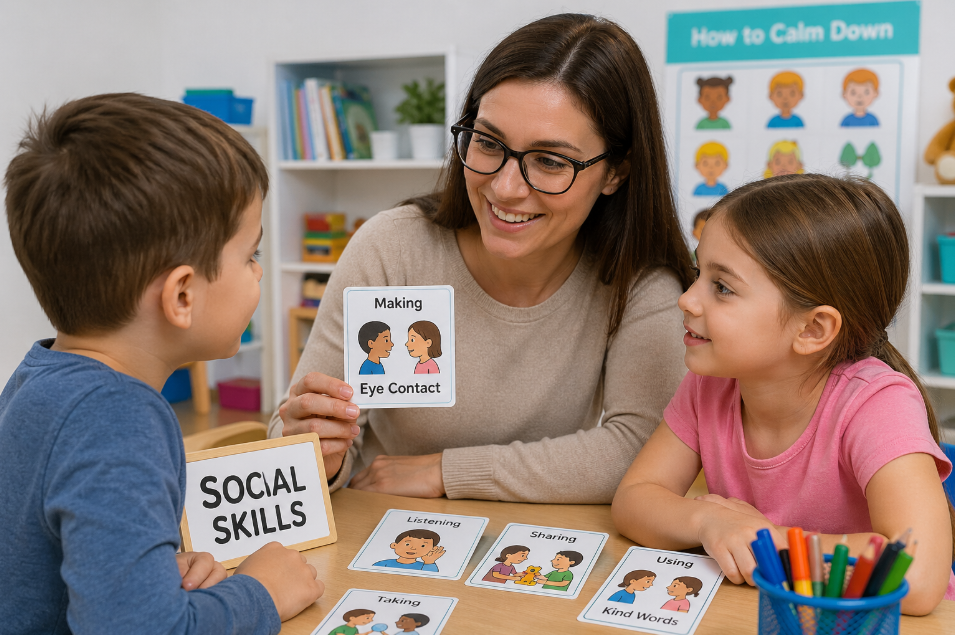
1. Use Role-Playing to Teach Real-Life Situations
One of the most effective ways to teach social behavior is through role-playing.
A lesson I learned
I once watched a parent prepare their child for the first day of school by pretending to be the teacher. They practiced saying “Good morning,” raising a hand to ask questions, and standing in line.
At first, the child seemed unsure and quiet. But after repeating the role-play several times, the child became more confident. When the real school day came, the routine felt familiar rather than scary.
How parents can apply this
You can role-play situations like:
- Meeting a new friend
- Asking for help
- Sharing toys
- Ordering food in a restaurant
Role-playing allows children to practice social rules in a safe and comfortable environment before facing them in real life.
2. Practice Social Skills Through Games
Games are powerful teaching tools because they naturally involve rules, turn-taking, and cooperation.
A lesson I learned
During a therapy session, two children were playing a simple ball game. At first, one child kept holding the ball and didn’t want to pass it.
Instead of correcting him immediately, the therapist turned the situation into a learning opportunity by saying, “Now it’s my turn, then your friend’s turn.”
After several rounds, the child started passing the ball without reminders. The game had quietly taught an important social rule — sharing and taking turns.
Try games like:
- Catch or kicking a ball
- Simon Says
- Hide and Seek
- Board games like Connect Four or Jenga
These activities teach social interaction in a fun and natural way.
3. Use Videos and Real-Life Observation
Children with autism often learn better by watching others first.
A lesson I learned
A parent once told me their child was afraid of visiting the dentist. Instead of forcing the situation, they watched short videos together showing children calmly sitting in the dentist chair and talking to the doctor.
By the time the actual appointment arrived, the child already understood what would happen. The anxiety was much lower.
How parents can use this method
You can show videos or observe people in situations like:
- Greeting someone politely
- Visiting a doctor or dentist
- Ordering food
- Playing in a playground
Watching others helps children understand what behavior is expected in social situations.
4.Use Social Stories to Explain Behavior
Social stories are short narratives that explain how people behave in different situations.
They help children understand:
- What is happening
- How people feel
- What behavior is expected
A lesson I learned
One teacher created a social story for a child who often grabbed toys from classmates. The story explained how friends feel when toys are taken and how asking politely makes people happy.
Within a few weeks, the child began saying, “Can I play with that?” instead of grabbing the toy.
How to create your own social story
A simple story might look like this:
“Sometimes my friends are playing with toys. If I want the toy, I can ask politely. My friend may say yes or wait for their turn. When I ask nicely, my friends feel happy.”
Stories like this help children visualize appropriate social behavior.
5. Encourage Interaction With Other Children
Children with autism can learn many social behaviors by observing and interacting with peers.
A lesson I learned
A family once arranged weekly playdates for their child who struggled with social interaction. At first, the child played alone while the other kids interacted.
But after several weeks, something changed. The child started copying what the others were doing — sharing toys, laughing, and even starting conversations.
This shows that peer interaction can naturally encourage social learning.
Simple ways to encourage interaction
- Arrange small playdates
- Join structured group activities
- Encourage cooperative games
- Choose activities your child enjoys
Gradual exposure helps children build confidence in social environments.
Supporting Social Skills at Home and School
Social skills develop best when parents, teachers, and therapists work together.
Teachers can help by:
- Creating a comfortable classroom environment
- Encouraging participation in activities
- Modeling good social behavior
At home, parents can reinforce these lessons by:
- Practicing conversations
- Using visual aids
- Playing social games
- Talking about emotions and feelings
Consistency across environments helps children apply the same social skills everywhere.