
Childhub Crawling Brain Development Blog 2026
Is Your Baby Not Crawling Yet? Why This Milestone Matters More Than You Think
Parents often ask:
“My baby skipped crawling… should I be worried?”
It’s a common concern — especially when family members say things like “Every child develops differently” or “They’ll walk anyway.”
While every child does follow their own developmental timeline, crawling is more than a step before walking. It plays an important role in building the foundation for learning, coordination, attention, and sensory development.
At ChildHub, we help families understand the deeper connection between movement and development so parents can identify challenges early and support their child with confidence.
Why Crawling Is More Than Just Movement
Most parents see crawling as a physical milestone.
Development specialists see it differently.
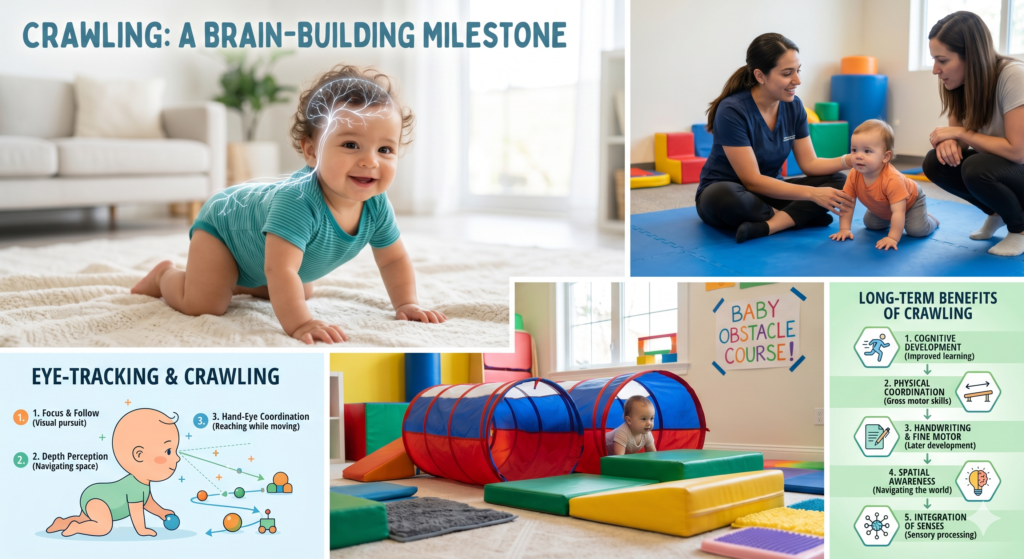
When babies crawl, they use cross-body movement — right arm with left leg, then left arm with right leg.
This movement pattern helps:
- Strengthen communication between both sides of the brain
- Improve coordination and body awareness
- Support visual tracking skills
- Build balance and spatial awareness
- Develop foundations for reading and learning
Small movements during infancy can influence larger developmental skills later.
Why Therapists Pay Attention To Crawling
During crawling, children are doing much more than moving across the floor.
They are simultaneously developing:
Eye Tracking Skills
Babies learn to look ahead while moving.
These ocular motor skills later support:
- Reading across a page
- Copying information
- Following moving objects
- Sports and hand-eye coordination
Vestibular Development
Movement activates the vestibular system, which helps children understand:
- Balance
- Motion
- Spatial orientation
- Body position
Sensory Integration
Weight through hands and knees provides important sensory input.
This helps children build stronger awareness of their bodies and surroundings.
What If Your Baby Skipped Crawling?
Skipping crawling does not automatically mean something is wrong.
But sometimes children avoid crawling because they need additional support with:
- Core strength
- Coordination
- Motor planning
- Sensory processing
- Movement confidence
Many parents assume babies simply “choose” not to crawl.
In reality, there can be developmental reasons behind the behavior.
Early support can help identify what your child needs.
ChildHub’s Approach: Looking Beyond Milestones
At ChildHub, we do more than observe developmental checklists.
We focus on understanding why a child may be struggling and create personalized strategies built around:
✔ Movement-based learning ✔ Sensory integration principles ✔ Parent coaching ✔ Child-centered therapy ✔ Play-based developmental activities
Our goal is not just helping children reach milestones.
Our goal is building strong developmental foundations.
Simple Ways Parents Can Encourage Crawling
Try these therapist-inspired activities:
- Place favorite toys slightly out of reach
- Create mini pillow obstacle courses
- Practice rocking in hands-and-knees positions
- Encourage supervised stair crawling
- Use playful floor activities and movement games
Keep activities fun and pressure-free.
Children learn best through connection and play.
When Should Parents Seek Support?
If your child:
- avoids tummy time
- only army crawls briefly
- strongly resists floor play
- struggles with coordination
- skips movement milestones
it may help to speak with a developmental professional.
Early support often creates meaningful long-term benefits.
Ready To Support Your Child’s Development?
Small movements can create big impact.
If you have questions about crawling, movement, sensory development, or milestones, ChildHub is here to help.
Book a consultation today and discover personalized strategies designed around your child.
Or explore more expert developmental insights through ChildHub resources.